


Indian publishers already have the readers advertisers want to reach. In 2025, India’s digital advertising grew 26% to ₹947 billion and made up 63% of total ad revenues (FICCI-EY). The demand is there. The harder part is packaging your inventory into curated deals that buyers can actually use, without giving up control of the supply path.
This post is a plain-language look at Curate, Rediads’ supply-side product for packaging publisher inventory into curated deals.
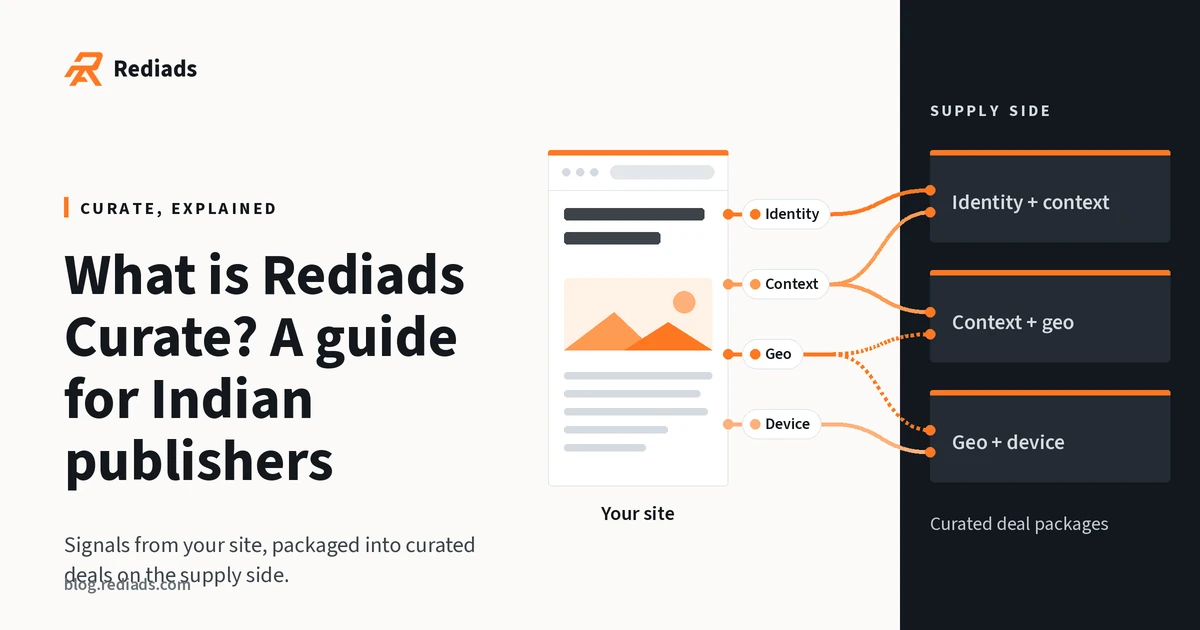
What Curate is
Curate packages publisher inventory into curated deals for buyers. Its job is packaging: taking the impressions you already sell and turning them into deals that help buyers reach the audiences they care about, on your sites.
Think of the difference between selling raw impressions and offering a deal a buyer can plan against. Raw inventory is hard to explain in a media plan. A curated deal gives it structure: which inventory, which signals, and which path. Curate is Rediads’ product for that packaging step.
Curate isn’t a demand-side platform, and it doesn’t replace your direct sales team. It’s a supply-side product, so the deal is built from the inventory you control rather than assembled only on the buy side.
In short, you bring the inventory, and Curate helps package it into curated deals that buyers can activate.
The signals behind a package
A curated deal is only as useful as the signals behind it. Curate uses four:
- Identity, from Rediads ID, helps with recognition across ad requests, where the publisher uses it and consent allows.
- Page context reflects what the reader is looking at, so the page itself is the signal rather than a borrowed audience label.
- Device and geo add the practical dimensions buyers already expect in a deal brief.
Rediads ID is Rediads’ official Prebid.js user ID module. It was merged into Prebid.js in April 2026 and is documented on Prebid.org. We’ll cover setup and consent in the next post in this series. For now, the point is simple: packaging starts from signals publishers can stand behind, not from a black-box score.
Why “supply side” matters for publishers
A lot of curation in the market is assembled for buyers first. The deal is built upstream of the publisher, and the publisher becomes a fulfilment source. That can work commercially, but it can leave publishers with less visibility into how their inventory was packaged and what fees sat in the path.
Curate works the other way: it matches audiences with publisher inventory on the supply side.
That matters if you care about control. When packaging sits with the publisher, the supply path stays closer to the people who have the readers. You’re packaging your own inventory into deals you can describe, rather than lending it to someone else’s audience product.
We want publishers to be able to see the supply path and the fees. That’s the standard we’re building toward: clear packaging and a path you can explain.
What we’re not promising
We’d rather be clear about what this post doesn’t say. We’re not quoting performance numbers like CTR, ROAS, eCPM or win rates, and we’re not promising higher CPMs. Results depend on your inventory and the buyers you work with, so we’d rather talk about your setup than quote averages.
Getting started
If you’d like to talk through how Curate could package your inventory, write to [email protected]. Tell us how you monetise today and whether you already run Prebid. That’s enough to start a useful conversation.
Rediads also runs Rediads Direct SSP, our programmatic supply platform, with Prebid Server-based auctions (including AMP) that give publishers access to programmatic demand, including PG and PMP deals.
Next in this series: Rediads ID, the Prebid.js module behind the identity signal in curated deals.
