Client-Side vs Server-Side Bidding
Header bidding can run in the reader’s browser or on a server. Swipe each card to the side it belongs to, client-side or server-side, before the clock runs out.
What you’ll learn
- How client-side Prebid.js and Prebid Server differ
- Why server-side bidding needs cookie syncing
- Where each one is used: websites, apps, AMP and CTV
Client-side
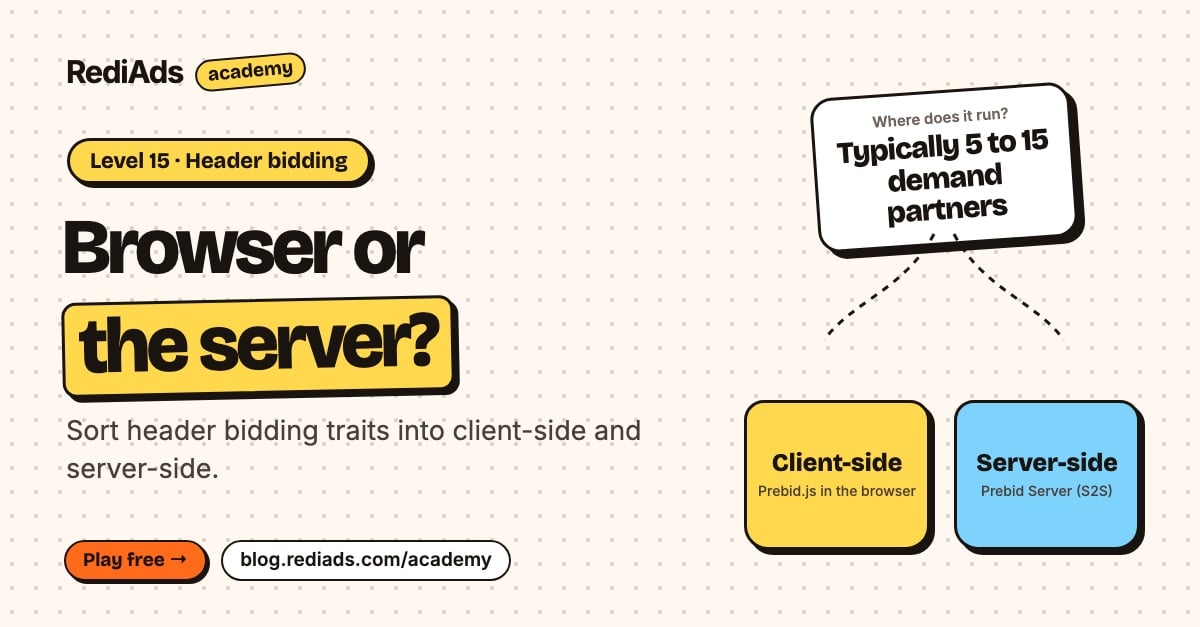
With Prebid.js, the auction runs in the reader’s browser. Each bidder’s adapter calls its SSP straight from the page, so bidders can read their own cookies where the browser allows. Every extra bidder adds work for the page; Prebid.org says client-side setups typically use 5 to 15 demand partners.
Server-side
With Prebid Server (server-to-server, or S2S), the page sends one request and the server calls the bidders. That lightens the load on the browser and is how apps, AMP pages and CTV bid. Because bidders’ cookies live on their own domains, Prebid Server needs cookie syncing to pass their reader IDs.
Using both
Prebid.js can send some bidders to Prebid Server and keep others in the browser. Prebid’s hb_source key-value lets you report client-side and server-side results side by side, so you can test which works better for each bidder.
Key terms
- Prebid.js
- The open-source library that runs header bidding in the browser.
- Prebid Server
- Open-source software for server-to-server header bidding.
- S2S
- Server-to-server: bidders are called from a server, not the page.
- Cookie sync
- Matching a bidder’s user ID with the ID a server-side system uses.
Level 15 leaderboard
No scores yet. Be the first on the board!