Floor Prices
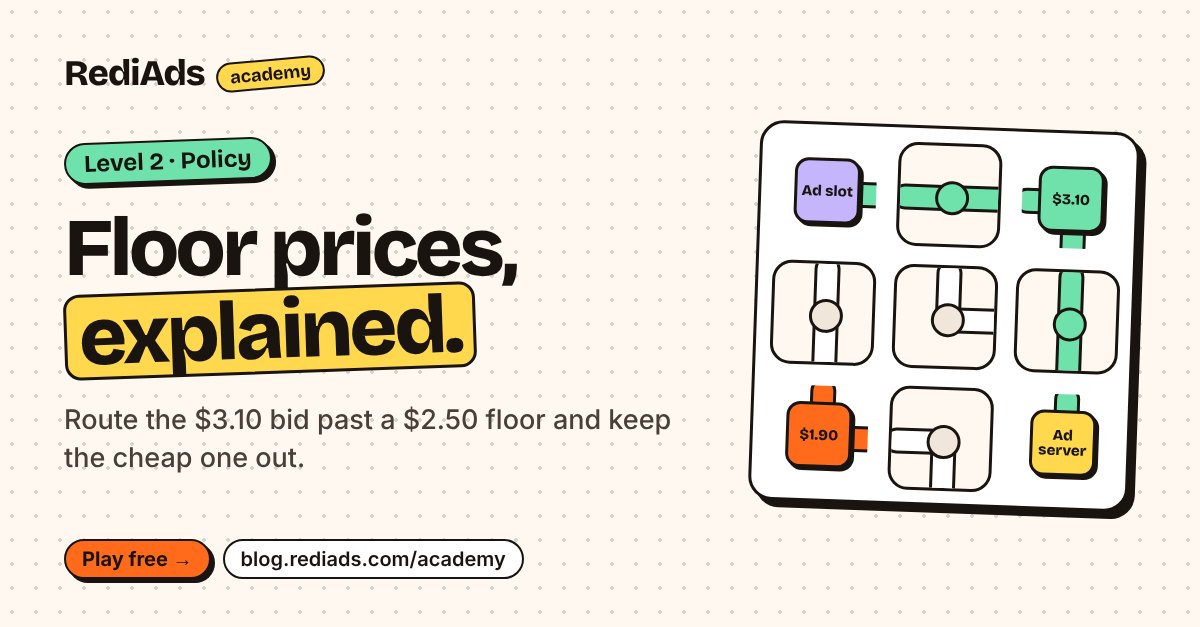
A floor price is the lowest bid a publisher will accept for an ad slot. In this puzzle a $1.90 bid is sneaking under the $2.50 floor. Re-route the pipes so only the $3.10 bid reaches the ad server.
What you’ll learn
- What a floor price is
- Why bids under the floor are rejected
- How floors that are too high cost fill
What is a floor price?
A floor price (or reserve price) is the minimum CPM a publisher will accept for an impression. Any bid below it is rejected, so the slot is never sold cheaper than the publisher decided it is worth.
Setting floors well
Floors are a balance. Too low and buyers win impressions cheaply. Too high and fewer bids clear, so more slots go unfilled. Many publishers set different floors by country, device, ad size or buyer, and adjust them with data rather than guesswork.
Floors in first-price auctions
Most programmatic auctions are now first-price: the winner pays what it bid. That makes the floor the main lever a publisher has over the price, alongside attracting more competition.
Key terms
- Floor price
- The lowest bid a publisher will accept.
- CPM
- Cost per mille: the price for 1,000 impressions.
- Fill rate
- The share of ad requests that end up showing an ad.
- First-price auction
- The winning bidder pays exactly what it bid.
Level 2 leaderboard
- 1Jatin1,000