 1:07
OM SDK: how viewability gets measured in apps
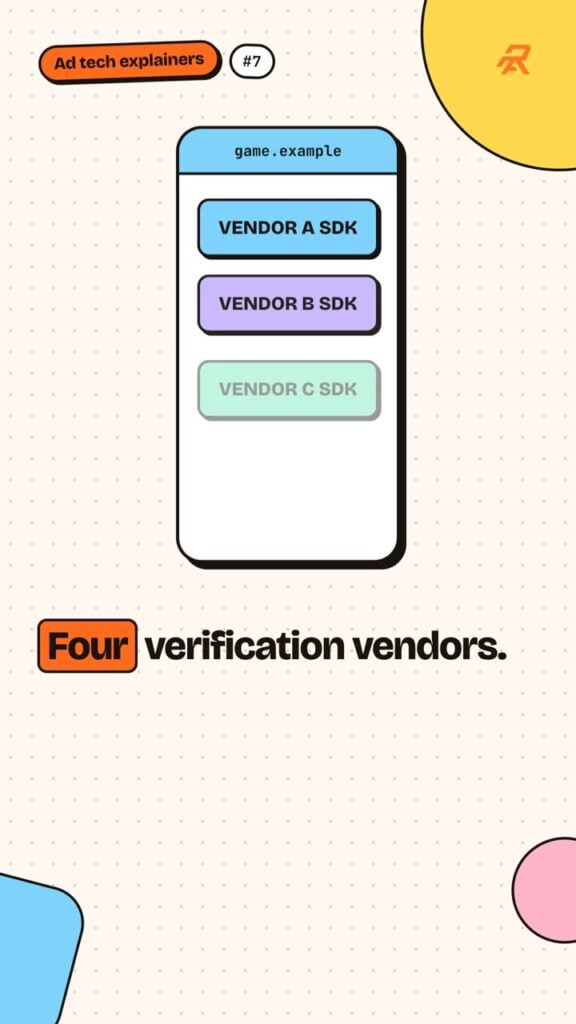
One game app. Four verification vendors. Four separate SDKs.
Lesson notes
One game app. Four verification vendors. Four separate SDKs.
The fix is OM SDK, the Open Measurement kit, one shared measurement layer for every vendor.
Before twenty eighteen, each verification firm, the companies brands hire to check ads were seen, wanted its own code in your app. More weight, more crashes, numbers that didn’t match. In April twenty eighteen, IAB Tech Lab released OM instead. Here’s game.example. Its ad SDK includes OM once. Each ad brings a small script from the brand’s vendor. OM reports how much of the ad is on screen, and for how long. The vendor applies the rule. Display, half the pixels for one second. Video, two seconds.
Your check. Confirm your ad SDK supports Open Measurement. Without it, vendors can’t verify your in-app impressions.
Next: SHARC, the standard meant to replace SafeFrame and M-RAID.
Up next in this series
 1:05SHARC: the standard meant to replace SafeFrame and MRAID
SHARC: the standard meant to replace SafeFrame and MRAID
 1:08DSA transparency in the EU bid stream
DSA transparency in the EU bid stream
 1:09The IAB spiders and bots list
The IAB spiders and bots list
 1:21Agentic ad protocols: ARTF and AAMP
Agentic ad protocols: ARTF and AAMP
 1:10CoMP: getting paid when AI crawls your content
CoMP: getting paid when AI crawls your content
 1:25OpenRTB started with block lists
OpenRTB started with block lists
 1:18Header bidding, in one story
Header bidding, in one story
 1:24Who actually handled this impression? (schain)
Who actually handled this impression? (schain)
 1:05Inside an OpenRTB bid request
Inside an OpenRTB bid request
 1:01buyers.json and DemandChain: the buyer-side mirror
buyers.json and DemandChain: the buyer-side mirror
 1:05ads.cert: signing the bid request
ads.cert: signing the bid request