 1:01
Ep 9: More bidders, more revenue? Not past a point
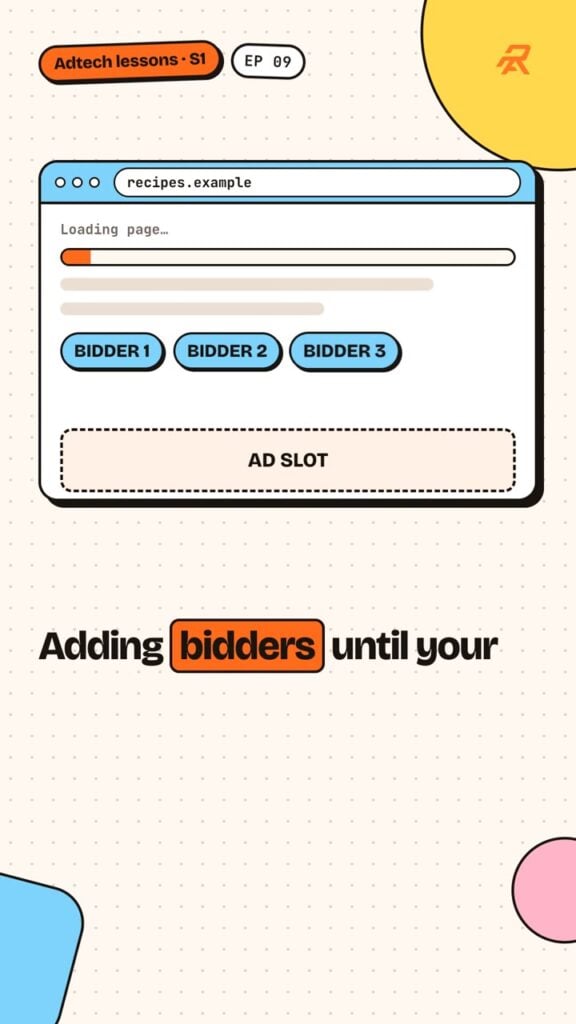
The mistake. Adding bidders until your page crawls.
Lesson notes
The mistake. Adding bidders until your page crawls.
Diminishing returns means each extra bidder adds less revenue than the one before.
Picture recipes.example adding bidders one at a time. These numbers are illustrative. With one bidder, the top bid averages one fifty. A second brings new buyers, and it jumps to two dollars. A third, two twenty. A fourth, two twenty five. Why the slowdown? Many SSPs reach the same DSPs, so a later bidder often brings buyers you already have. Meanwhile every bidder adds a request and more waiting. Prebid dot org’s own tests saw revenue with five bids plateau, and revenue drop when the page waited too long.
Rank bidders by the revenue only they bring. Test removing the weakest with a holdout before adding another.
Next, header bidding timeouts.
 Go deeper · 2 min readRTC Auctions: A Comprehensive Guide to Header Bidding
Up next in this series
 0:54Ep 10: Header bidding timeouts
Ep 10: Header bidding timeouts
 1:03Ep 1: One ad, 100 milliseconds
Ep 1: One ad, 100 milliseconds
 1:00Ep 2: Waterfall vs header bidding
Ep 2: Waterfall vs header bidding
 0:42Ep 3: Supply path — count your hops
Ep 3: Supply path — count your hops
 1:03Ep 4: ads.txt and sellers.json, the guest list buyers check
Ep 4: ads.txt and sellers.json, the guest list buyers check
 0:57Ep 5: Client-side vs server-side header bidding
Ep 5: Client-side vs server-side header bidding
 0:58Ep 6: Curate vs PMPs
Ep 6: Curate vs PMPs
 0:38Ep 7: Higher CPM, lower revenue
Ep 7: Higher CPM, lower revenue
 1:03Ep 8: Price floors, the number that can raise or sink revenue
Ep 8: Price floors, the number that can raise or sink revenue