 1:03
Ep 8: Price floors, the number that can raise or sink revenue
Myth. A higher price floor always means higher revenue.
Lesson notes
Myth. A higher price floor always means higher revenue.
A price floor is the lowest CPM you’ll accept for an impression.
Buyers see your floor in the bid request. Here’s when it helps. A buyer values your slot at three dollars but expects little competition, so it plans to bid one sixty. With a two dollar floor, it must bid two to stay in. You earn forty cents more CPM. Here’s when it hurts. Raise the floor to three fifty. That buyer values the slot at three, so it doesn’t bid, and nobody else clears it. The impression goes unsold, or to a house ad. Revenue is CPM times filled impressions. Higher CPM on fewer impressions can mean less money.
After any floor change, compare revenue and fill rate, not CPM alone. Change one floor at a time.
Next, more bidders, more revenue? Not past a point.
 Go deeper · 4 min readFloor Price: Your Key to Revenue Optimization
Up next in this series
 1:01Ep 9: More bidders, more revenue? Not past a point
Ep 9: More bidders, more revenue? Not past a point
 0:54Ep 10: Header bidding timeouts
Ep 10: Header bidding timeouts
 1:03Ep 1: One ad, 100 milliseconds
Ep 1: One ad, 100 milliseconds
 1:00Ep 2: Waterfall vs header bidding
Ep 2: Waterfall vs header bidding
 0:42Ep 3: Supply path — count your hops
Ep 3: Supply path — count your hops
 1:03Ep 4: ads.txt and sellers.json, the guest list buyers check
Ep 4: ads.txt and sellers.json, the guest list buyers check
 0:57Ep 5: Client-side vs server-side header bidding
Ep 5: Client-side vs server-side header bidding
 0:58Ep 6: Curate vs PMPs
Ep 6: Curate vs PMPs
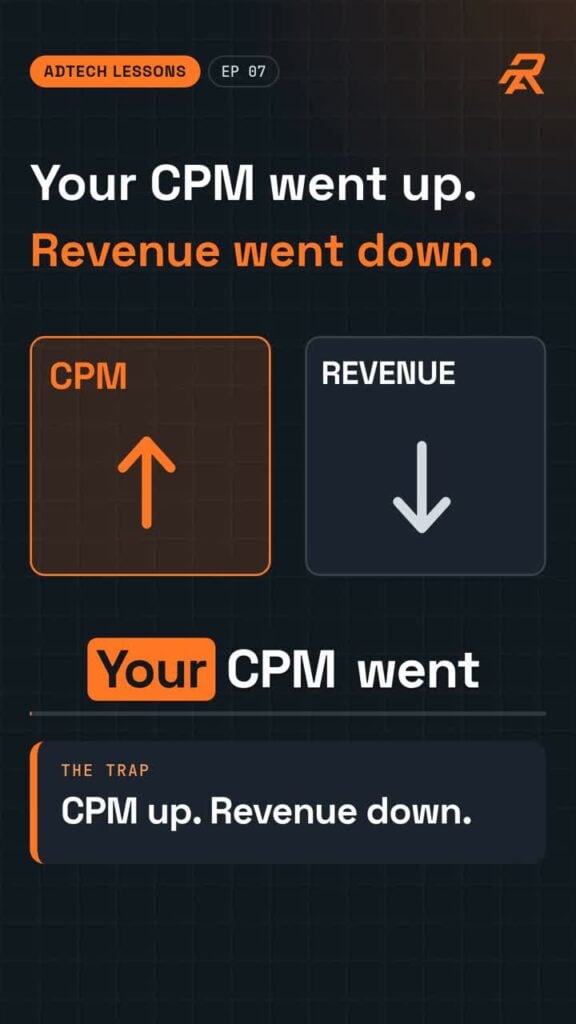 0:38Ep 7: Higher CPM, lower revenue
Ep 7: Higher CPM, lower revenue