 1:07
Ep 2: How a page asks for an ad: the GPT tag
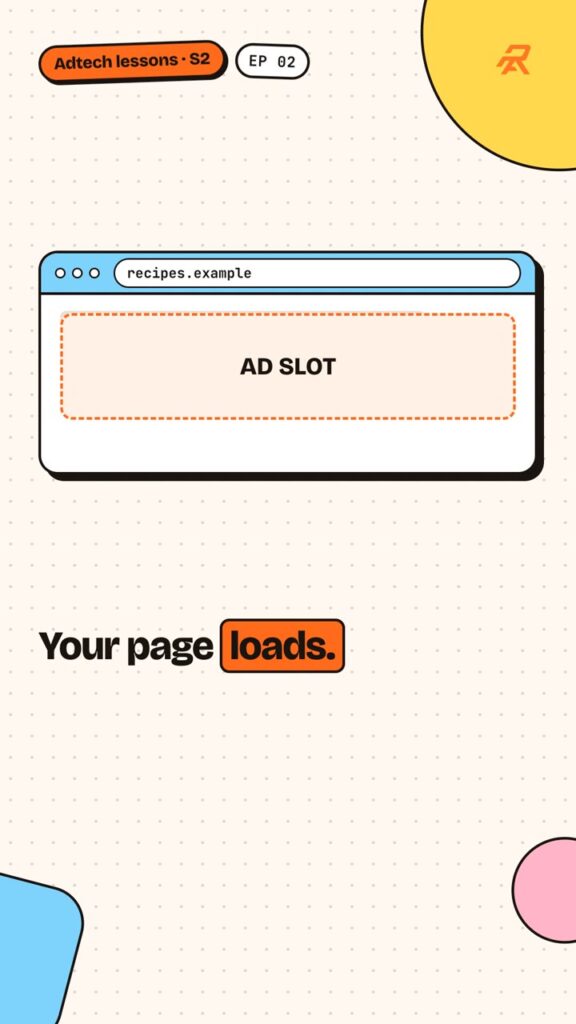
Your page loads. Then one small script asks Google for an ad.
Lesson notes
Your page loads. Then one small script asks Google for an ad.
The Google Publisher Tag, or GPT, is the code that requests ads from Ad Manager.
On recipes.example it works in four steps. First, load the GPT library from Google. Second, define a slot. Ad unit path,/one two three four/recipes/top. Size, three hundred by two fifty. And the box where the ad goes. Third, add key values, like section equals desserts. Fourth, display. GPT sends one ad request to Ad Manager with the ad unit, size, page address and key values. Ad Manager picks a winner and returns the creative, and GPT draws it in the box.
Check one page today. Does the tag’s ad unit path match Ad Manager exactly? A mismatch means targeted line items miss it.
Next, orders, line items and creatives in one minute.
 Go deeper · 13 min readDemystifying Google Ad Manager: A Comprehensive Guide
Up next in this series
 1:05Ep 3: Orders, line items, creatives
Ep 3: Orders, line items, creatives
 1:06Ep 4: Line item priorities
Ep 4: Line item priorities
 1:00Ep 5: Key-values: how header bidding talks to Ad Manager
Ep 5: Key-values: how header bidding talks to Ad Manager
 1:03Ep 6: Dynamic allocation
Ep 6: Dynamic allocation
 1:03Ep 7: Open Bidding, Google’s server-side header bidding
Ep 7: Open Bidding, Google’s server-side header bidding
 0:57Ep 8: First-price auctions and bid shading
Ep 8: First-price auctions and bid shading
 1:07Ep 9: Pricing rules after the Google ruling
Ep 9: Pricing rules after the Google ruling
 1:03Ep 10: Protections and blocks
Ep 10: Protections and blocks
 1:05Ep 1: AdSense vs Ad Manager vs AdX
Ep 1: AdSense vs Ad Manager vs AdX