 0:57
Ep 8: First-price auctions and bid shading
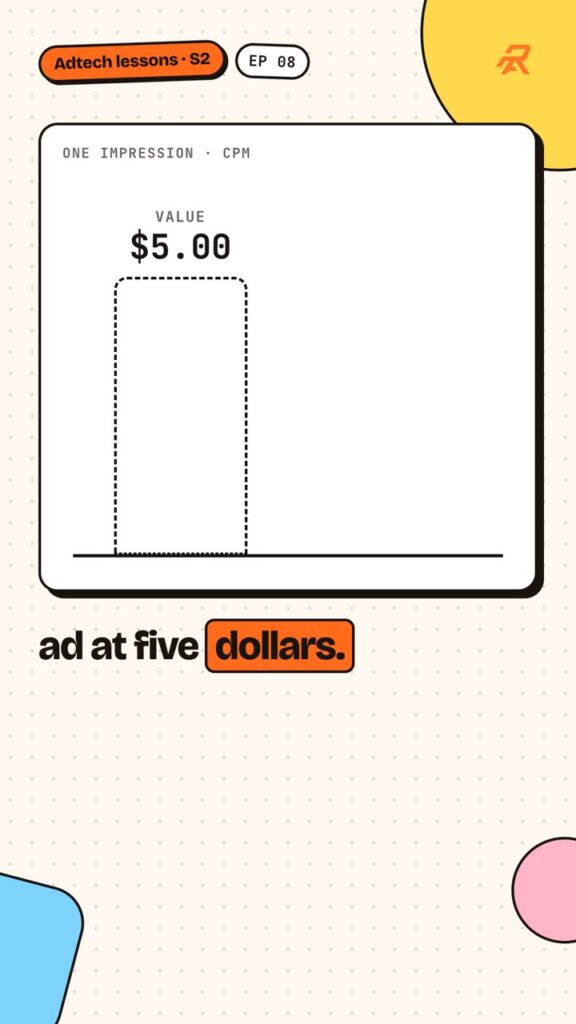
A buyer values your ad at five dollars. It bids three twenty.
Lesson notes
A buyer values your ad at five dollars. It bids three twenty.
Bid shading means a buyer bids below its true value to avoid overpaying.
Ad Manager has run a unified first price auction since twenty nineteen. The winner pays what it bids. In the old second price auctions, the winner paid just above the runner up. Value five, next bid three, price about three dollars and one cent. In first price, an honest five dollar bid pays five. So buyer software learns what usually wins on your site, and bids just enough. If three twenty usually wins, it bids three twenty. What pushes shaded bids back up? More real competition, and floors close to what buyers really value.
Lower bids don’t always mean weaker demand. Check competition and floors before you panic.
Next, pricing rules after the Google ruling.
 Go deeper · 5 min readBid Shading Uncovered: Smart Bidding for Maximum Ad Impact
Up next in this series
 1:07Ep 9: Pricing rules after the Google ruling
Ep 9: Pricing rules after the Google ruling
 1:03Ep 10: Protections and blocks
Ep 10: Protections and blocks
 1:05Ep 1: AdSense vs Ad Manager vs AdX
Ep 1: AdSense vs Ad Manager vs AdX
 1:07Ep 2: How a page asks for an ad: the GPT tag
Ep 2: How a page asks for an ad: the GPT tag
 1:05Ep 3: Orders, line items, creatives
Ep 3: Orders, line items, creatives
 1:06Ep 4: Line item priorities
Ep 4: Line item priorities
 1:00Ep 5: Key-values: how header bidding talks to Ad Manager
Ep 5: Key-values: how header bidding talks to Ad Manager
 1:03Ep 6: Dynamic allocation
Ep 6: Dynamic allocation
 1:03Ep 7: Open Bidding, Google’s server-side header bidding
Ep 7: Open Bidding, Google’s server-side header bidding